
Our Guide To Keeping Checkerboard Discus Fish
-
About Fish Species:
- Scientific name: Symphysodon aequifasciatus
- Common name: Checkerboard Discus
- Family: Cichlidae
- Origin: Captive-bred colour strain derived from South American Discus originating from the Amazon River Basin
- Adult length: 15 to 20 cm
- Lifespan: 8 to 12 years
- Diet: Omnivore
- Care Level: Advanced
- Temperament: Peaceful, but can be territorial when breeding
-
Tank Setup:
- Checkerboard Discus are large, social cichlids that require a spacious aquarium with excellent water quality. A minimum tank size of around 300L is recommended for a suitable group of adult Discus, with larger aquariums providing additional swimming space and greater water stability.
- Discus should generally be kept in groups of at least six individuals unless an established breeding pair is being maintained separately. Keeping an appropriate group allows natural social behaviour and helps distribute aggression within the hierarchy.
- Provide plenty of open swimming space together with sheltered areas created using tall plants, smooth driftwood and vertical structures. Suitable plants can include Amazon Swords, Anubias and Java Fern, provided they are able to tolerate the consistently warm water required by Discus.
- A fine sand substrate works well in a natural-style aquarium. Bare-bottom aquariums are also sometimes used for growing or breeding Discus because uneaten food and waste can be removed easily.
-
Water Parameters:
- Checkerboard Discus prefer warm, soft to moderately soft water. A pH range of approximately 6.0 to 7.5 is suitable for most captive-bred specimens when the water chemistry remains stable.
- Keep the water temperature between 27 to 30°C (81 to 86°F).
- Stable water conditions are particularly important for Discus. Ammonia and nitrite should remain at zero, while nitrate should be kept as low as reasonably possible through good maintenance and regular partial water changes.
- Avoid sudden changes in temperature, pH or hardness when carrying out aquarium maintenance or introducing replacement water.
-
Filtration and Water Flow:
- Use efficient biological and mechanical filtration capable of maintaining excellent water quality while handling the waste produced by a group of relatively large fish.
- Checkerboard Discus prefer gentle to moderate water movement and should not be exposed to excessively strong or turbulent currents. Good oxygenation remains important, particularly because warm aquarium water contains less dissolved oxygen than cooler water.
- Regular filter maintenance, partial water changes and prompt removal of uneaten food will help maintain the clean and stable conditions required by Discus.
-
Diet:
- Checkerboard Discus are omnivores and should receive a varied, nutritionally balanced diet. High-quality Discus granules or pellets can form the basis of their diet.
- Supplement prepared foods with suitable frozen foods such as brine shrimp, mysis and bloodworms to provide dietary variety.
- Feed sensible portions that the fish can consume promptly and remove uneaten food to prevent deterioration in water quality.
- Juvenile Discus generally benefit from smaller, more frequent meals to support healthy growth, while established adults can be fed less frequently.
-
Tank mates:
- Checkerboard Discus are generally peaceful and can be kept with carefully selected community fish that are comfortable at the consistently high temperatures required by Discus.
- Suitable tank mates can include Cardinal Tetras, Rummynose Tetras, peaceful Corydoras species that tolerate warmer water and other calm South American community fish with compatible requirements.
- Avoid aggressive or territorial species, persistent fin-nippers and extremely active fish that may stress the Discus or repeatedly outcompete them for food.
- Care should be taken when selecting plecos and other suckermouth catfish because some individuals may attempt to graze on the protective mucus coating of slow-moving Discus.
-
Behavior and Compatibility:
- Checkerboard Discus are social cichlids that establish a hierarchy within their group. Some displaying and chasing is normal, but sufficient aquarium space, visual barriers and an appropriately sized group help prevent excessive aggression towards subordinate fish.
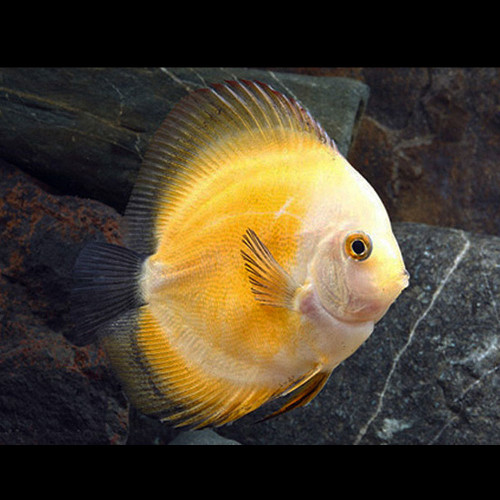
- The Checkerboard Discus is a selectively bred variety recognised for its intricate pattern of intersecting lines and markings, which can produce a distinctive checkerboard-like appearance across the body and fins. Pattern, intensity and base colour can vary between individual fish.
- When a compatible breeding pair forms, the fish may become more territorial and select a vertical surface such as a broad plant leaf, piece of wood or spawning cone on which to deposit their eggs.
- Both parents participate in guarding the eggs and caring for the developing young. Newly free-swimming Discus fry initially obtain nutrition by feeding on specialised mucus secretions produced on the skin of their parents.
- Checkerboard Discus are best suited to aquarists able to provide consistently warm, clean and stable water, an appropriate social group and a carefully managed feeding and aquarium maintenance routine.
(No reviews yet)

Write a Review