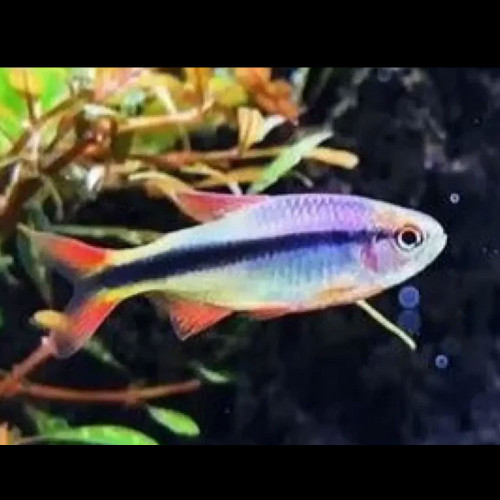


Our Guide To Keeping Lapis Tetra Fish
-
About Fish Species:
- Scientific name: Hyphessobrycon cyanotaenia
- Common name: Lapis Tetra
- Family: Acestrorhamphidae
- Origin: Upper Rio Juruena and Rio Guaporé river systems, Mato Grosso, Brazil
- Adult length: 4 cm
- Lifespan: Around 4 to 5 years
- Diet: Omnivore
- Care Level: Easy to Moderate
- Temperament: Peaceful
-
Tank Setup:
- Lapis Tetras are active shoaling fish that appreciate a well-planted aquarium with plenty of open swimming space. A minimum tank size of around 60L is suitable for a small group, although a larger aquarium is recommended for a more substantial shoal.
- Provide areas of dense planting around the sides and rear of the aquarium while leaving the centre relatively open for swimming. Plants such as Java Fern, Anubias, Cryptocoryne and floating plants can help create a natural environment.
- Dark substrate, subdued lighting, pieces of driftwood and dried leaves can be used to recreate the tannin-rich conditions found in their natural habitat and can also help enhance their attractive blue colouration.
-
Water Parameters:
- Lapis Tetras prefer soft, slightly acidic to neutral water. Maintain a pH range of approximately 5.5 to 7.0 for best results.
- Keep the water temperature between 23 to 28°C (73 to 82°F).
- Soft to moderately soft water is preferred, particularly when attempting to reproduce conditions similar to their natural South American habitat.
-
Filtration and Water Flow:
- A gentle to moderate water flow is ideal for Lapis Tetras. Use an efficient aquarium filter that maintains excellent water quality without creating excessively strong currents.
- Regular partial water changes are important because these small tetras perform best in clean, stable and mature aquarium conditions.
-
Diet:
- Lapis Tetras are omnivores and readily accept a varied aquarium diet. Feed a good-quality small flake, micro pellet or finely granulated food as their regular staple diet.
- Supplement their diet with small live or frozen foods such as daphnia, baby brine shrimp, cyclops and bloodworms. A varied diet helps maintain good condition and encourages their characteristic blue and metallic colouration.
- Offer small portions once or twice each day, providing only as much food as the fish can consume within a few minutes.
-
Tank mates:
- Lapis Tetras are peaceful shoaling fish and should be kept in groups of at least six individuals. A group of eight to twelve or more will generally produce more natural behaviour, greater confidence and a more attractive display.
- Suitable tank mates include other peaceful tetras, rasboras, pencilfish, Corydoras catfish, small peaceful plecos, dwarf cichlids and other similarly sized community fish.
- Avoid housing them with large predatory fish or highly aggressive species that may intimidate or prey upon these relatively small tetras.
-
Behavior and Compatibility:
- Lapis Tetras are active, peaceful fish that spend much of their time swimming in the middle levels of the aquarium. Their striking blue longitudinal colouration is particularly attractive when they are maintained in a healthy shoal.
- Males can display territorial behaviour towards one another and may engage in short displays or harmless sparring, but serious aggression is unusual when sufficient space and hiding areas are provided.
- Males are generally more intensely coloured and can develop more elongated dorsal and anal fins, while females tend to be slightly less colourful and fuller-bodied.
- Keeping a larger group allows natural social interactions to be spread between several individuals and usually results in more confident behaviour and stronger colouration.
(No reviews yet)

Write a Review