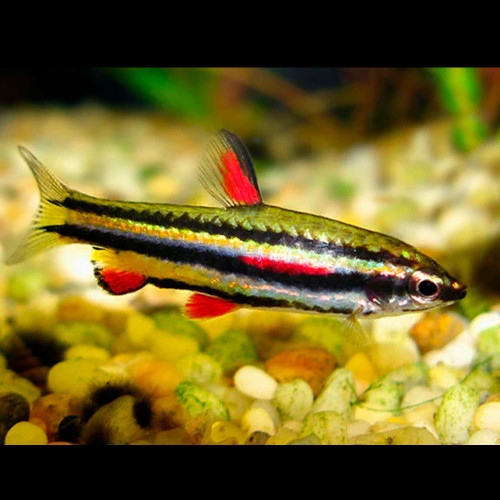


Our Guide To Keeping Purple Pencilfish
-
About Fish Species:
- Scientific name: Nannostomus rubrocaudatus
- Common name: Purple Pencilfish
- Family: Lebiasinidae
- Origin: Peru, South America
- Adult length: 3 to 4 cm
- Lifespan: 3 to 5 years
- Diet: Omnivore
- Care Level: Moderate
- Temperament: Peaceful, with occasional displaying between males
-
Tank Setup:
- Purple Pencilfish are small, peaceful shoaling fish that are best maintained in a well-planted aquarium. A minimum tank size of around 60L is recommended for a group, although a larger aquarium provides additional swimming space and allows a larger shoal to be maintained.
- Keep Purple Pencilfish in a group of at least six individuals, with a larger group of eight or more preferable where space allows. Maintaining a suitable group helps the fish feel secure and encourages natural social and displaying behaviour.
- Provide dense planting around the sides and rear of the aquarium while retaining open areas for swimming. Floating plants are particularly useful for creating the subdued lighting these fish appreciate.
- Driftwood, branches and aquarium-safe leaf litter can be used to create a natural South American-style environment with plenty of shaded areas and visual cover.
-
Water Parameters:
- Purple Pencilfish prefer soft, slightly acidic to neutral water with a pH range of approximately 5.5 to 7.0.
- Keep the water temperature between 23 to 28°C (73 to 82°F).
- Stable water conditions and consistently good water quality are important. Avoid sudden changes in temperature or water chemistry, particularly when introducing newly acquired fish.
-
Filtration and Water Flow:
- Purple Pencilfish prefer gentle water movement and should not be exposed to excessively strong currents. A mature sponge filter or appropriately controlled internal or external filter is suitable.
- Maintain good water quality with regular partial water changes while avoiding large or sudden changes in water parameters.
- These fish are best introduced to a mature, biologically stable aquarium rather than a newly established setup.
-
Diet:
- Purple Pencilfish are omnivorous micropredators that naturally feed on tiny invertebrates and other small food items. Their small mouths mean appropriately sized foods should always be provided.
- Offer high-quality crushed flakes, micro granules or other small prepared foods as part of a varied diet.
- Supplement prepared foods regularly with small live or frozen foods such as baby brine shrimp, Cyclops, daphnia and appropriately sized mosquito larvae.
- Feed small portions that can be consumed easily, ensuring less dominant individuals within the group have an opportunity to feed.
-
Tank mates:
- Purple Pencilfish are peaceful and are best kept with similarly small, calm species that share their preference for soft, warm water.
- Suitable tank mates can include small tetras, other peaceful pencilfish, hatchetfish, small Corydoras and peaceful dwarf cichlids.
- Avoid large or aggressive fish that may view Purple Pencilfish as prey, as well as highly active or boisterous species that may intimidate them or consistently outcompete them for food.
-
Behavior and Compatibility:
- Purple Pencilfish are social fish and should be maintained in a group rather than individually. A good-sized shoal provides security and allows their natural interactions to be observed.
- Mature males can display towards one another and may establish small temporary territories. These interactions are usually displays rather than serious aggression when the aquarium provides sufficient space and visual cover.
- The species is particularly valued for its striking colouration, with mature specimens displaying contrasting dark lateral markings together with rich reddish-purple tones and distinctive red colouration towards the caudal region.
- Purple Pencilfish can be relatively shy when first introduced. Subdued lighting, floating plants, plenty of cover and peaceful tank mates will help them settle and encourage confident natural behaviour.
(No reviews yet)

Write a Review