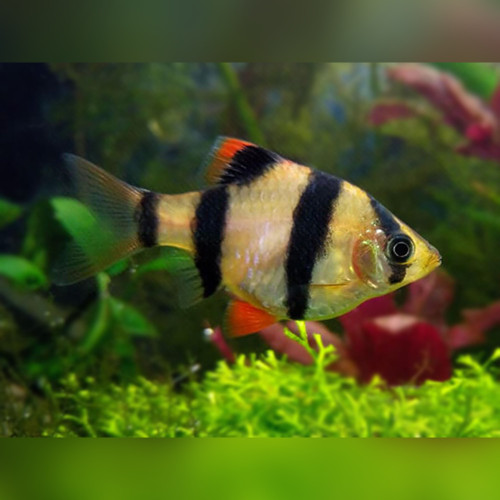


Our Guide To Keeping Wild Gold Barb Fish
-
About Fish Species:
- Scientific name: Barbodes semifasciolatus
- Common name: Wild Gold Barb
- Family: Cyprinidae
- Origin: Southern China, Taiwan and northern Vietnam
- Adult length: 5 to 7 cm
- Lifespan: 5 to 7 years
- Diet: Omnivore
- Care Level: Easy
- Temperament: Peaceful
-
Tank Setup:
- Wild Gold Barbs thrive in a well-planted aquarium with plenty of open swimming space. A minimum tank size of 75L is recommended for a small group, although a larger aquarium is preferable.
- Decorate the aquarium with driftwood, rounded rocks and hardy aquatic plants such as Java Fern, Anubias and Vallisneria. A dark substrate helps enhance their natural golden and green colouration.
- As an active schooling species, they should be kept in groups of at least six individuals to reduce stress and encourage natural shoaling behaviour.
-
Water Parameters:
- Wild Gold Barbs prefer slightly acidic to neutral water with a pH range of 6.0 to 7.5.
- Maintain the water temperature between 18 to 24°C (64 to 75°F).
- They are adaptable to a range of water conditions provided the aquarium is mature and water quality remains consistently high.
-
Filtration and Water Flow:
- Provide efficient filtration with a gentle to moderate water flow that replicates the slow-moving streams and rivers they naturally inhabit.
- Carry out regular partial water changes to maintain excellent water quality and promote long-term health.
-
Diet:
- Wild Gold Barbs are omnivores and readily accept high-quality tropical flakes, micro pellets and granules as their staple diet.
- Supplement their diet with live or frozen foods such as bloodworms, daphnia, mosquito larvae and brine shrimp to encourage vibrant colours and natural behaviour.
- Vegetable-based foods including spirulina flakes and blanched spinach or courgette can also be offered as part of a balanced diet.
-
Tank mates:
- Wild Gold Barbs are peaceful community fish that do best when kept in groups of six or more.
- Suitable tank mates include Danios, Rasboras, White Cloud Mountain Minnows, peaceful Tetras, Corydoras, Loaches and other similarly sized community fish.
- Avoid housing them with large predatory fish or highly aggressive species that may bully or prey upon them.
-
Behavior and Compatibility:
- Wild Gold Barbs are active, inquisitive and constantly on the move, making them an excellent addition to peaceful community aquariums.
- Keeping them in a proper-sized school greatly reduces any occasional fin-nipping behaviour and allows them to display their natural social interactions.
- The wild form displays more olive-green and bronze tones than the selectively bred Gold Barb, making it particularly attractive in natural-style planted aquariums.
(No reviews yet)

Write a Review